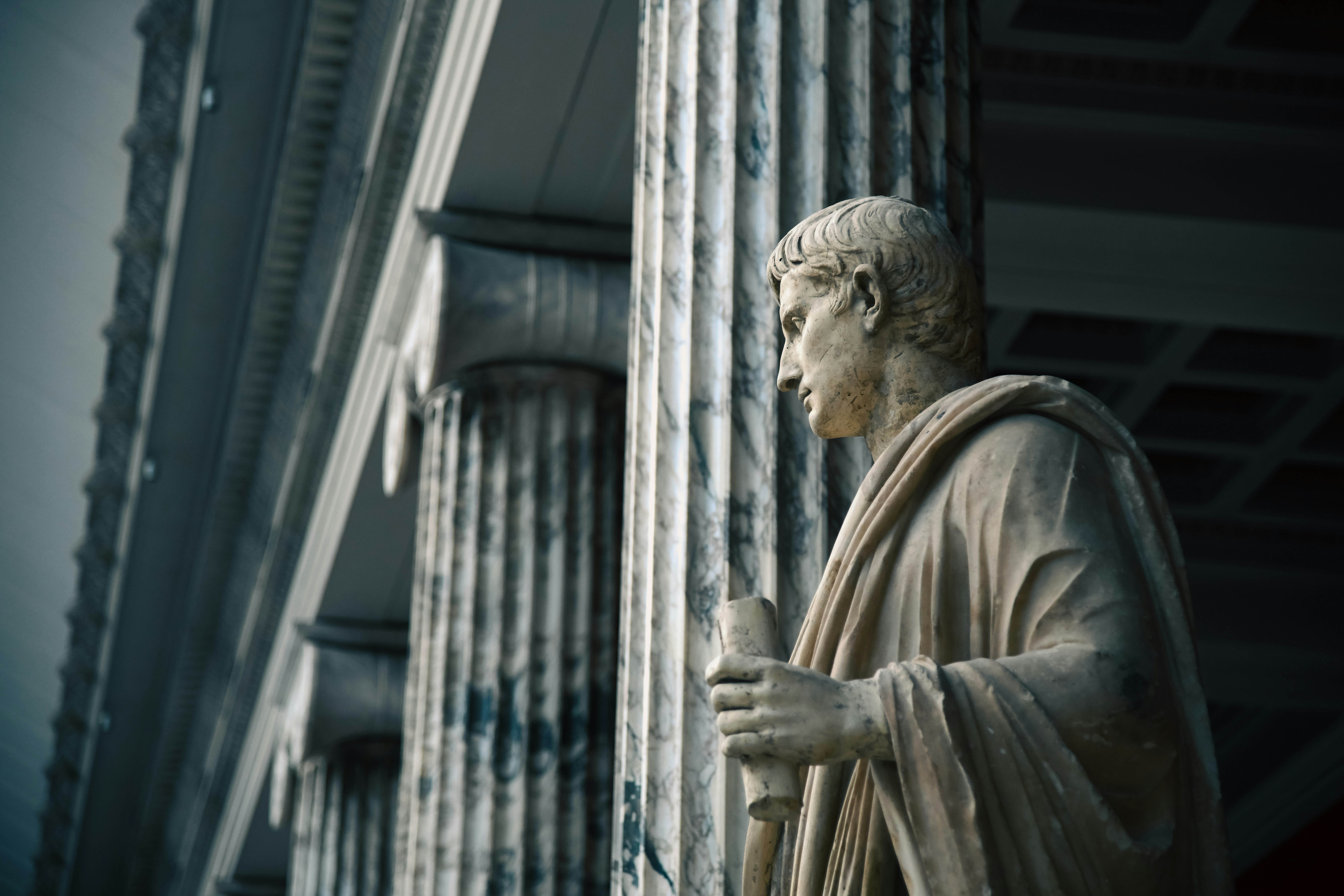
The Modern Virtuous Man
Within Greco-Roman philosophy, the “virtuous person” is someone who has achieved complete internal harmony.
Harmony through:
- reasoning
- virtue
- self-mastery
Rather than existing as a static state, becoming virtuous is an ongoing process of refining one’s character through reason, self-mastery, and service to the community.
While a lot has changed about our physical world since ancient Greece and Rome, these same thoughts can still be true in the digital age.
Stoicism and Platonic Thinking In The Digital Age
While Stoicism emphasizes the neutrality of tools, Plato’s concern with appearances suggests that certain technologies may systematically encourage ways of thinking that distance us from truth.
The Greco-Roman perspective on technology does not classify it as “good” or “bad”. Instead, a Stoic views it as a preferred indifferent, while a Platonist sees it as pharmakon. This means it is a tool entirely dependent on the user, and their intentionality.
To build the “virtuous person” in the digital age, you must reconcile the usage of these modern tools with the preservation of one’s soul.
The Stoic: Preferred Indifferent
To a stoic, technology is an external. It is not evil, nor is it virtuous. However, in the digital age these tools can affect our character. Technology is a preferred indifferent because it can aid virtuous action without constituting virtue itself. Technology becomes a dispreferred indifferent when its use undermines one’s ability to exercise reason and virtue.
-
The Framework: A Stoic would evaluate technology by the “Test of Agency.” If you use social media to share wisdom, coordinate community action, or acquire genuine knowledge, you are practicing virtue. If an algorithm dictates your life, if it dictates your mood, fragments your focus, or demands your outrage, you have become a slave.
-
The Application: Ancient stoicism would likely lead to digital minimalism. The “virtuous person” uses hardware and software with precision. Once the work is done, the tool is set down. Notifications, feeds, and long-form videos are removed entirely.
The Platonic View: Technology as a Pharmakon
In Phaedrus, Socrates (as presented by Plato) describes writing as a pharmakon, both a remedy and a poison.
Plato argues that writing encourages the appearance of wisdom rather than genuine understanding, which is cultivated through dialectic.
-
The Framework: Plato might argue how digital media colonizes the consciousness. He would warn that if you offload your memory to a smartphone, you are atrophying the very “muscles” required to reach truth.
-
The Application: A Platonist would ask: Does this technology bring me closer to the Forms (truth/beauty/justice), or does it keep me in the Cave (shadows/images/opiates)? If you use tech to engage in dialectic (genuine dialogue, questioning, and learning), it is a ladder to the light. If you use it to consume “shadows” (infinite scrolls, rage-bait, algorithmic content), it is a shackle.
A Modern Synthesis of Both Philosophies
The modern “virtuous person” must consciously bridge the gap between digital output and integrity.
| Aspect | The “Incomplete” Approach | The “Complete” Approach |
|---|---|---|
| Hardware/Software | Consuming for comfort or entertainment. | Mastering as a techne (art/craft). |
| Social Media | Seeking validation or distraction. | Using for Koinonia (community) and connection. |
| FAANG/Algorithms | Allowing algorithmic incentives to determine what receives your attention. | Recognizing the algorithm as a “shadow” to remain objective. |
| AI Integration | Outsourcing judgment to AI. | Using AI to “interrogate” and sharpen your own dialectic. |
Conclusion
To be the “virtuous person” in this era, you must be tech-literate to understand the mechanisms of our systems. However, you must stay anchored enough to abstract the technology from the virtuous life. Utilize your devices, code, hardware to facilitate human excellence, search for truth, rather than as objects to define your self-worth.
Sources
| Category | Source/Author | Relevance |
|---|---|---|
| Ancient Foundations | Plato, Phaedrus | Introduces the pharmakon (remedy/poison) concept. |
| Ancient Foundations | Marcus Aurelius, Meditations | The foundational text for Stoic self-mastery, focus, and internalizing the ‘citadel’ against distractions. |
| Ancient Foundations | Epictetus, Enchiridion / Discourses | Provides the practical manual for the ‘dichotomy of control’. |
| Modern Application | Cal Newport, Digital Minimalism | Applies the Stoic/minimalist philosophy to modern digital tools. |
| Media Theory | Marshall McLuhan, Understanding Media | Explores how technology acts as an ‘extension of man’. |
| AI/Tech Ethics | Various Contemporary Studies (e.g., ‘Plato’s AI Pharmacy’) | Modern synthesis applying ancient frameworks to the ethics of algorithms/AI. |
| Stoic Modernism | Taylor Emerson, The Modern Stoic | Bridges ancient virtues and disciplined living. |